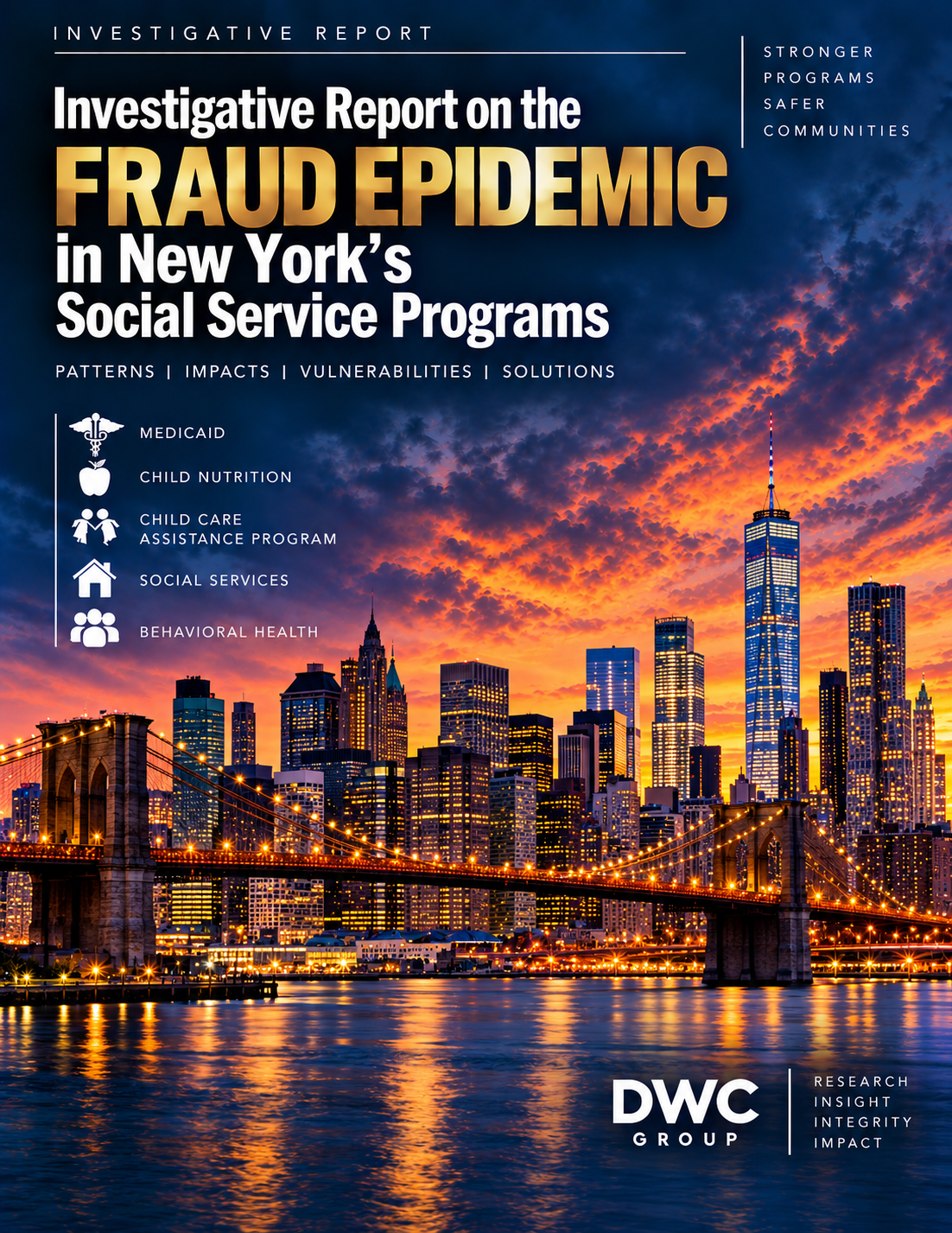
Description
Investigative Report on the Fraud Epidemic in New York’s Social-Service Programs
Medicaid Fraud • Social-Service Oversight • Program Integrity • Fraud Analytics • Government Accountability
An investigative and policy-focused examination of fraud risks, improper payments, oversight vulnerabilities, and emerging program-integrity challenges across New York’s massive Medicaid and social-service ecosystem.
New York operates one of the largest and most complex public-benefit systems in the United States. With billions of dollars flowing through Medicaid, managed care, home and community-based services, behavioral health, developmental-disability programs, childcare subsidies, nutrition programs, and other safety-net services, effective fraud detection and financial oversight are critical.
Prepared by DWC Group, this report examines how weaknesses in documentation, provider monitoring, payment verification, data sharing, and government oversight can create opportunities for fraud, waste, abuse, and improper payments—and presents a framework for detecting higher-risk activity before losses escalate.
What This Report Examines
The report investigates major fraud-risk areas across New York’s social-service infrastructure, including:
Medicaid & Healthcare Billing Risks
Examine vulnerabilities affecting home and community-based services, behavioral health, personal care, case management, developmental-disability supports, and other high-volume service categories.
Phantom Services & Billed-but-Not-Provided Claims
Explore risk patterns involving services billed without sufficient corresponding timesheets, attendance records, progress reports, staffing evidence, or other supporting documentation.
Childcare Subsidy & Attendance Risks
Analyze vulnerabilities involving inflated attendance, billing-to-capacity discrepancies, weak documentation, decentralized oversight, and post-payment verification within subsidized childcare programs.
Nutrition & Emergency-Meal Programs
Examine potential risks involving overstated rosters, phantom meals, rapid billing growth, insufficient verification, and weaknesses in locally administered nutrition programs.
Rapid-Growth & Higher-Risk Providers
Learn how sudden increases in claims without corresponding increases in clients, staffing, facilities, or operating capacity can function as early-warning indicators.
Cross-State Provider & Geographic Risks
Explore how provider ownership, operating location, client geography, staffing, and billing activity can be cross-referenced to identify potentially unusual patterns.
Data Silos & Government Oversight
Understand how fragmented claims, attendance, payroll, eligibility, provider, and compliance databases can make suspicious patterns more difficult to identify in real time.
From Fraud Investigation to Fraud Prevention
A central focus of the report is transforming fraud patterns into actionable program-integrity controls.
It develops a proposed fraud-risk scorecard incorporating indicators such as:
• Rapid billing growth
• High per-client billing
• Occupancy-to-billing discrepancies
• Weak or incomplete documentation
• Backdated records
• Geographic mismatches
• Provider growth inconsistent with staffing
• Previous audit or compliance findings
• Out-of-state ownership and operating patterns
• Claims inconsistent with verified service activity
These indicators can be incorporated into a centralized fraud-risk dashboard to help program-integrity teams identify providers requiring additional scrutiny before suspicious activity develops into significantly larger financial exposure.
A Four-Phase Program-Integrity Framework
The report develops a practical framework for strengthening government oversight:
Phase 1 — Vulnerability Assessment
Identify high-risk programs, services, providers, payment structures, and systemic control weaknesses.
Phase 2 — Risk Scorecard & Analytics Dashboard
Apply measurable indicators to identify unusual billing growth, documentation deficiencies, phantom-service patterns, and other anomalies.
Phase 3 — Pre-Payment Controls & Real-Time Verification
Move beyond the traditional “pay first, investigate later” model by incorporating targeted pre-payment review and stronger service verification.
Phase 4 — Whistleblower & Governance Reform
Strengthen reporting channels, anti-retaliation safeguards, internal accountability, and coordination among oversight organizations.
The report’s framework is intended to move agencies from simply recognizing that fraud risk exists toward building controls capable of identifying and mitigating those risks.
Data Analytics for Program Integrity
The report goes beyond traditional investigative analysis by showing how fraud-risk indicators can be translated into measurable analytics.
Its proposed scorecard considers variables such as claims growth, client counts, staffing, verified attendance, documentation completeness, geographic discrepancies, and audit history. The resulting framework could support monthly or quarterly monitoring and help investigators prioritize limited enforcement resources toward providers presenting stronger combinations of risk indicators.
Who Should Read This Report?
Designed for professionals working in:
Federal & State Government • Medicaid Fraud Control Units • Inspectors General • Program Integrity • Healthcare Compliance • Medicaid Administration • Government Auditing • Law Enforcement • Financial Investigations • Government Contracting • Public Administration • Data Analytics • Risk Management • Internal Controls • Policy Research • Legislative Research • Government Consulting • Think Tanks • Academic Research
Government agencies and professionals can use this report as a reference for:
Fraud-risk assessments • Program-integrity planning • Medicaid oversight • Internal-control development • Government fraud analytics • Provider-risk monitoring • Pre-payment review strategies • Compliance research • Policy development • Investigative research • Public-administration education • Government accountability initiatives
Why This Report Matters
The central issue is not simply discovering fraud after public money has disappeared.
It is determining how governments can recognize the warning signs before questionable payments become major losses.
By examining recurring vulnerabilities and translating them into measurable red flags, risk-scoring concepts, verification controls, and governance reforms, this report provides a framework for thinking about the next generation of public-sector fraud prevention.
Prepared by DWC Group
Research • Insight • Integrity • Impact
This publication is intended for educational, research, policy-analysis, investigative, and professional reference purposes.
Reviews
There are no reviews yet.