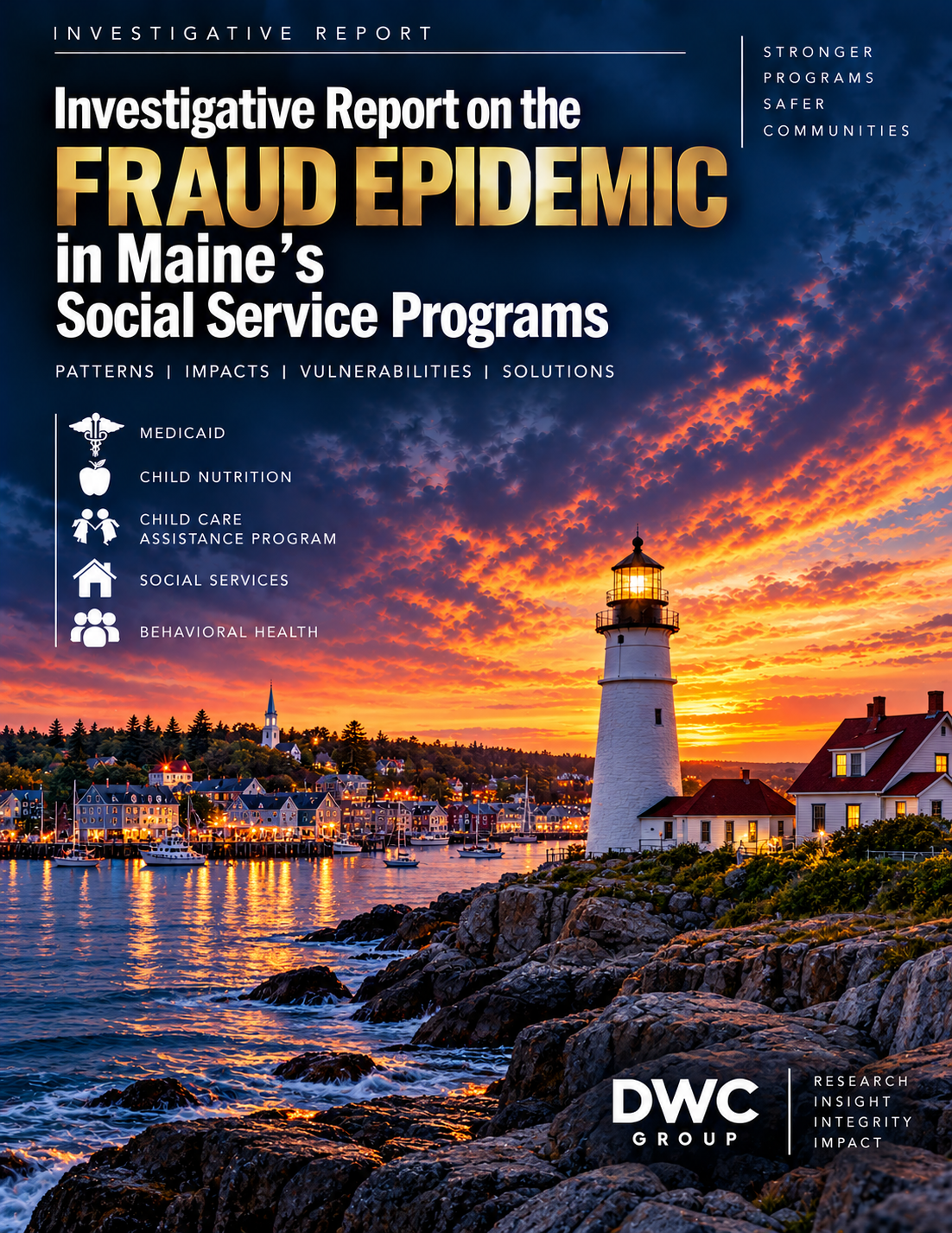
Description
Investigative Education Report on the Fraud Epidemic in Maine’s Social Service Programs
Fraud Risk • Medicaid Oversight • Program Integrity • Data Analytics • Government Accountability
A comprehensive investigative-education report examining fraud risks, systemic vulnerabilities, oversight weaknesses, and emerging program-integrity challenges across Maine’s Medicaid and social-service programs.
This report provides an in-depth examination of Maine’s publicly funded social-service ecosystem, with particular attention to Medicaid-funded services, home and community-based care, behavioral health, childcare subsidies, social-service contracting, provider oversight, and program integrity.
Rather than examining fraud solely after public funds have been lost, the report approaches Maine as a preventive case study—identifying the structural conditions and warning signs that can allow fraud, waste, abuse, improper billing, and weak documentation to grow into significantly larger public-finance problems.
Inside the Report
Medicaid & Social-Service Fraud Risk
Examine vulnerabilities within high-reimbursement and documentation-intensive services, including home-based personal care, behavioral health, residential treatment, disability services, housing-related supports, transportation, peer recovery, adult day services, and other community-based programs.
Childcare Subsidy & Attendance Fraud
Explore potential weaknesses surrounding subsidized childcare programs, including inflated attendance, billing that exceeds realistic capacity, weak documentation, post-payment verification, and the challenges created when payment growth outpaces fraud-detection capabilities.
Phantom Services & Improper Billing
The report examines risk patterns involving services billed but potentially not provided, maximum-authorized billing, insufficient supporting documentation, questionable attendance records, rapid provider growth, and discrepancies between billing, staffing, clients, and operational capacity.
“Fraud Tourism” & Cross-State Provider Risks
Explore how geographic and ownership mismatches, newly registered providers, rapid billing increases, out-of-state ownership, and limited local operating capacity can be incorporated into provider-risk analysis.
Data Silos & Oversight Gaps
The report examines how disconnected claims, eligibility, provider, attendance, payroll, and background-information systems can make it difficult for agencies to identify suspicious activity before payments occur.
A Data-Driven Fraud Detection Framework
A major component of the report is a proposed Maine-Type Fraud Risk Scorecard designed to help oversight bodies identify higher-risk providers and transactions.
Potential indicators include:
• Rapid billing growth
• Claims-to-client ratios
• Staffing-to-billing discrepancies
• Attendance-to-billing discrepancies
• Missing or incomplete documentation
• Backdated records
• Geographic and ownership mismatches
• Newly registered, high-volume providers
• Previous audit and compliance findings
• Higher-risk program and service categories
The report explains how these indicators could ultimately support a centralized fraud-risk dashboard capable of identifying providers for additional review.
Moving From “Pay and Chase” to Prevention
One of the report’s central recommendations is a shift away from relying predominantly on post-payment audits.
Instead, the report explores a proactive model incorporating:
Risk scoring → Pre-payment review → Documentation verification → Real-time attendance verification → Targeted site inspections → Investigation
Potential controls discussed include pre-payment documentation requirements, targeted reviews of higher-risk providers, billing controls for newly established providers, electronic attendance systems, GPS-based service verification, and other technology-enabled integrity measures.
Whistleblower Protection & Government Accountability
Fraud detection depends on more than technology.
The report also examines governance, organizational culture, internal controls, leadership accountability, whistleblower protections, independent reporting mechanisms, and interagency information sharing.
It considers how frontline employees, auditors, investigators, contractors, and program-integrity personnel can become an important early-warning system when appropriate reporting and anti-retaliation structures exist.
From Maine to a National Program-Integrity Model
Although focused on Maine, the report is structured as a broader fraud-risk and early-detection learning framework.
Its analytical concepts can help policymakers and oversight professionals examine similar vulnerabilities in Medicaid, childcare subsidies, behavioral health, community services, and other publicly funded programs in additional jurisdictions.
The report ultimately addresses one central question:
How can government identify high-risk providers and potentially improper claims before millions of dollars in public funds are lost?
Key Topics
Medicaid Fraud Risk • Program Integrity • Fraud Analytics • Childcare Subsidy Fraud • Phantom Billing • Provider Risk • Improper Payments • Internal Controls • Pre-Payment Audits • Real-Time Verification • Whistleblower Protection • Government Oversight • Fraud Detection • Data Analytics • Public Administration • Compliance • Government Accountability
Who Should Read This Report?
Designed for:
Federal & State Agencies • Medicaid Fraud Control Units • Program Integrity Teams • Policymakers & Legislators • Government Contractors • Inspectors General • Auditors • Investigators • Compliance Professionals • Healthcare Administrators • Government Consultants • Policy Researchers • Think Tanks • Attorneys • Academic Researchers • Public Administration Professionals • Data & Fraud Analysts
This report can serve as a professional research and educational resource for:
Government research • Policy development • Fraud-risk assessments • Medicaid program-integrity strategy • Compliance research • Government consulting • Internal-control development • Fraud analytics • Public-administration education • Investigative research • Oversight planning
Prepared by DWC Group
Research • Insight • Integrity • Impact
This publication is intended for educational, research, policy-analysis, investigative, and professional reference purposes.
Reviews
There are no reviews yet.