Description
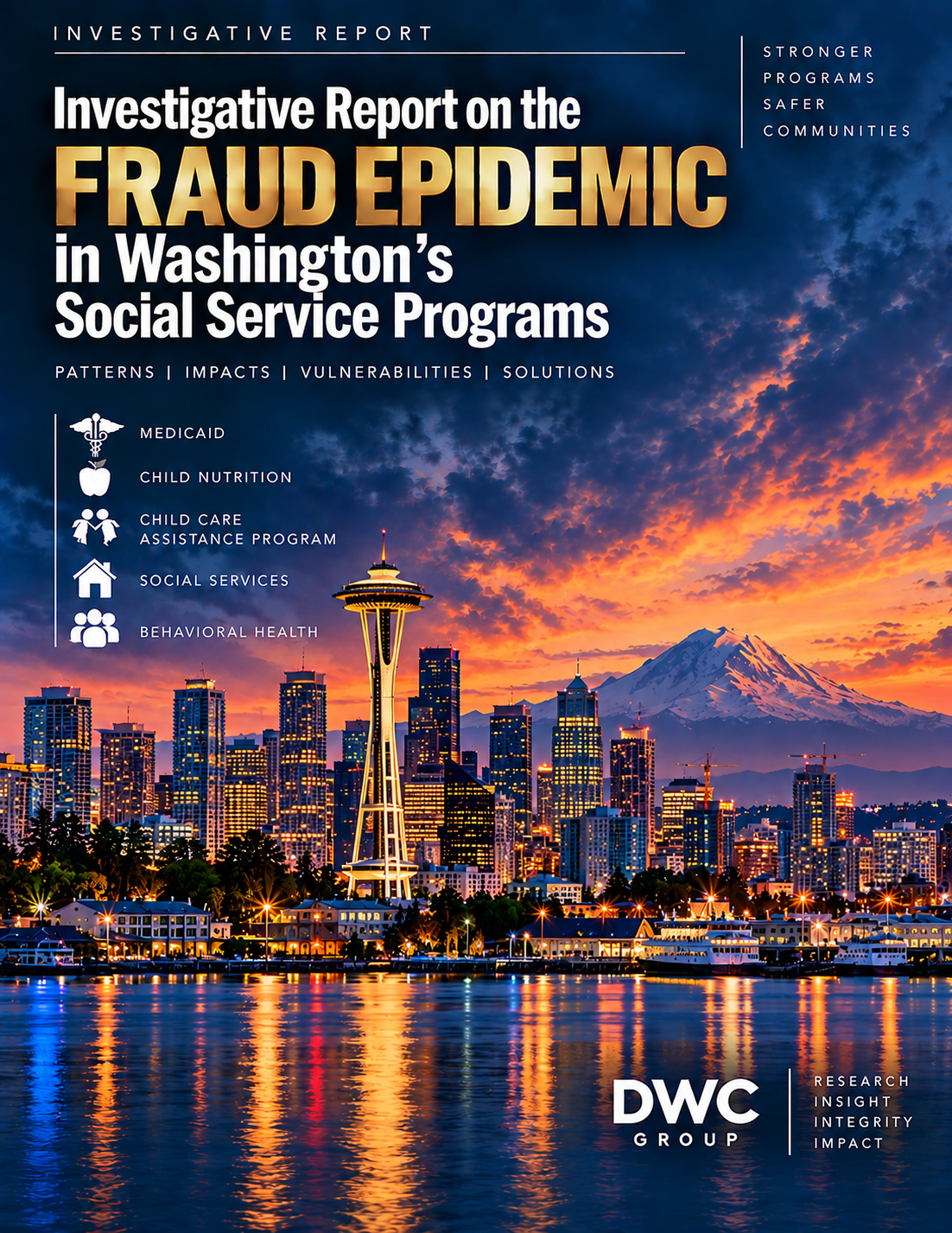
Investigative Report on the Fraud Epidemic in Washington State’s Social-Service Programs
Medicaid Fraud • Social-Service Oversight • Program Integrity • Fraud Analytics • Government Accountability
An investigative and policy-focused examination of fraud risks, improper payments, systemic vulnerabilities, and program-integrity challenges across Washington State’s Medicaid and social-service ecosystem.
Washington State administers a complex network of Medicaid-funded healthcare, home and community-based services, behavioral-health programs, long-term care, childcare subsidies, nutrition assistance, and other safety-net programs. The size and complexity of this system make strong financial controls, provider monitoring, documentation, and fraud detection essential to protecting public funds.
Prepared by DWC Group, this report examines how fragmented oversight, weak documentation, provider billing anomalies, post-payment verification, and disconnected government data systems can create opportunities for fraud, waste, abuse, and improper payments.
Rather than focusing solely on fraud after it occurs, the report explores how government agencies can identify early warning indicators and build stronger systems to detect questionable activity before losses escalate.
What the Report Covers
Medicaid & Healthcare Fraud Risks
Explore fraud vulnerabilities associated with home and community-based services, behavioral health, substance-use treatment, in-home support, long-term care, and other high-volume or high-reimbursement services.
The report examines patterns including rapid provider growth, unusually high billing, services billed without adequate supporting documentation, and claims that may not correspond with verified service delivery.
Phantom Services & Billed-but-Not-Provided Claims
The report examines the risks created when providers bill for authorized hours, therapy sessions, visits, or other services without corresponding timesheets, progress reports, sign-ins, staffing records, or other evidence demonstrating that services occurred.
Childcare Subsidy Fraud Risks
Examine potential weaknesses involving:
• Inflated attendance and billed hours
• Billing inconsistent with facility capacity
• Rapid provider billing growth
• Paper-based attendance systems
• Post-payment verification
• Weak occupancy controls
• Phantom-attendance risks
The report explains how decentralized verification can make improper payments harder to identify before funds have already been disbursed.
Data Silos & Government Oversight
One of the report’s central themes is the difficulty of detecting fraud when claims, payroll, attendance, eligibility, provider-background information, and compliance records exist in separate systems.
The report examines how these data blind spots can prevent agencies from identifying relationships between unusual billing patterns and real-world provider capacity.
Fraud-Risk Analytics & Provider Scorecards
A major component of the report is a proposed high-risk provider scorecard designed to help program-integrity teams prioritize providers and transactions for additional review.
Potential indicators include:
Growth Ratio — Claims growth compared with client and staffing growth.
Occupancy-to-Billing Ratio — Verified attendance compared with billed services.
Documentation Completeness — Availability of progress reports, monitoring records, sign-ins, and supporting documentation.
Geographic Mismatch — Unusual relationships between ownership, provider location, staffing, and client activity.
Audit History — Previous compliance findings, investigations, or other risk indicators.
The report proposes integrating these indicators into a centralized fraud-risk dashboard that could be updated monthly or quarterly and shared among program-integrity and oversight organizations.
From Post-Payment Investigation to Prevention
Traditional fraud enforcement often begins after questionable payments have already been made.
This report examines a different approach: identify risk earlier.
Its program-integrity framework explores pre-payment documentation controls, targeted audits, provider risk scoring, real-time service verification, stronger cross-agency data sharing, and enhanced whistleblower protections.
The report organizes this approach into four phases:
Phase 1 — Vulnerability Assessment
Identify high-risk programs, providers, services, payment structures, and systemic weaknesses.
Phase 2 — Risk Scorecard & Dashboard
Create measurable fraud-risk indicators capable of identifying unusual billing growth, phantom services, documentation weaknesses, and related anomalies.
Phase 3 — Pre-Payment Controls & Real-Time Verification
Apply additional verification and review to higher-risk providers before questionable payments leave government systems.
Phase 4 — Whistleblower & Governance Reform
Strengthen reporting mechanisms, anti-retaliation protections, accountability, and organizational culture.
Oversight, Investigations & Enforcement
The report also examines the relationship between government oversight, program-integrity operations, audits, investigations, enforcement, whistleblower reporting, internal controls, and institutional accountability.
Rather than treating fraud solely as the conduct of individual bad actors, the report considers the broader systems that can allow questionable activity to remain undetected—including fragmented oversight, inadequate verification, weak documentation, and insufficient coordination between agencies.
Recommendations for Government Agencies
The final section converts the report’s findings into proposed reforms for federal agencies, Washington State agencies, and other states.
Recommendations include stronger vulnerability assessments, provider-risk dashboards, pre-payment audit pilots, real-time verification, improved cross-state fraud detection, stronger whistleblower protections, and greater transparency around program-integrity performance.
Who Should Read This Report?
Designed for professionals working in:
Federal & State Government • Medicaid Fraud Control Units • Inspectors General • Program Integrity • Healthcare Compliance • Government Auditing • Financial Investigations • Law Enforcement • Public Administration • Government Contracting • Risk Management • Internal Controls • Data Analytics • Policy Research • Legislative Research • Social-Service Administration • Government Consulting • Think Tanks • Academic Research
This report can serve as a professional research and educational resource for:
Fraud-risk assessments • Medicaid program-integrity research • Provider-risk analysis • Internal-control planning • Government fraud analytics • Compliance research • Policy development • Investigative research • Pre-payment control strategies • Public-administration education • Government accountability initiatives
Why This Report Matters
Fraud prevention is not simply about identifying who committed fraud after public money has disappeared.
The larger challenge is determining whether government systems can recognize the warning signs before suspicious activity becomes a major financial loss.
By examining recurring vulnerabilities and translating them into measurable red flags, risk-scoring concepts, verification controls, and policy recommendations, this report presents a framework for strengthening the next generation of public-sector fraud prevention.
Prepared by DWC Group
Research • Insight • Integrity • Impact
For educational, research, policy-analysis, investigative, and professional reference purposes.
Reviews
There are no reviews yet.