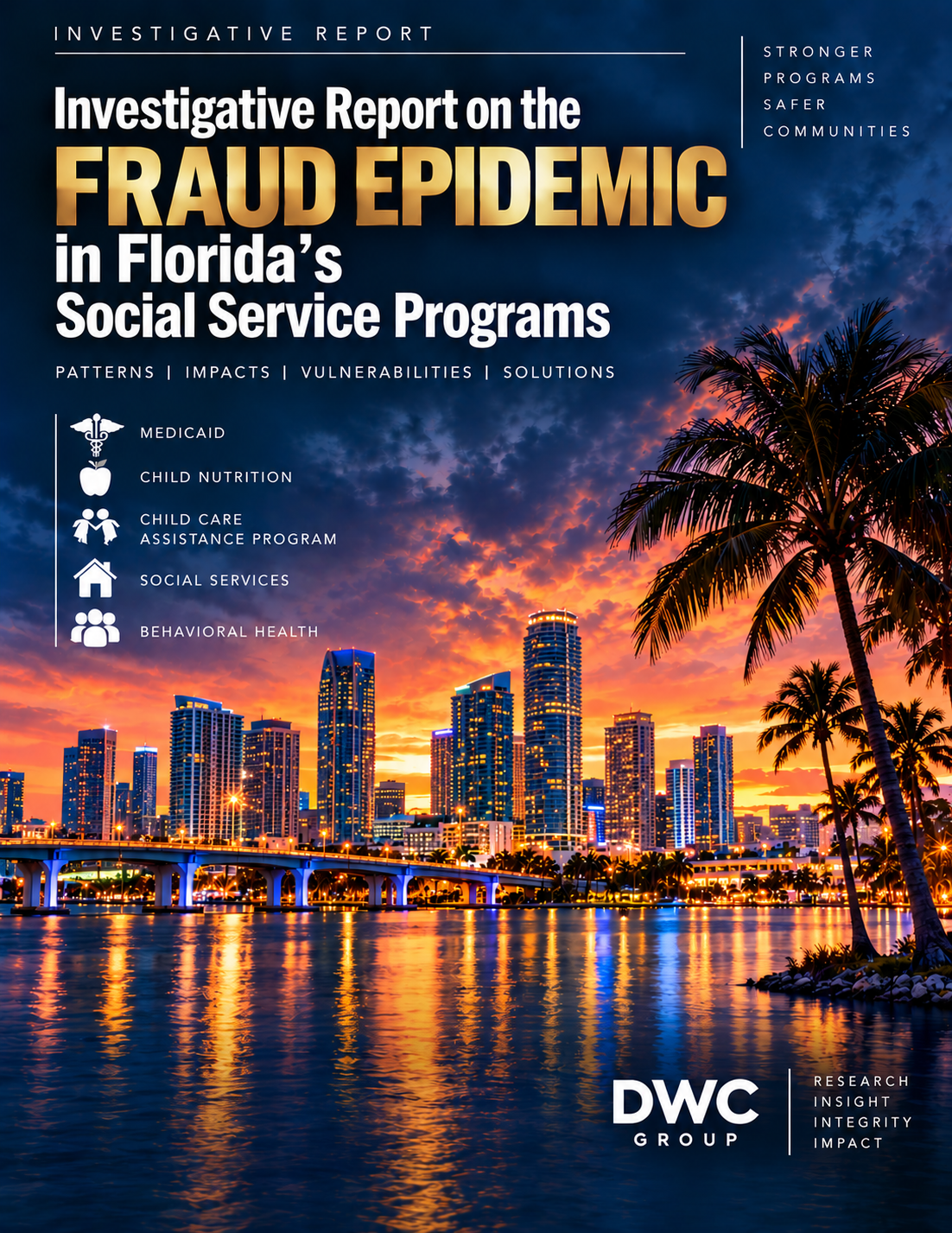
Description
Investigative Report on the Fraud Epidemic in Florida Social-Service Programs
An in-depth examination of fraud risks, program-integrity vulnerabilities, oversight gaps, data analytics, and prevention strategies across Florida’s Medicaid and social-service ecosystem.
Prepared by DWC Group, this investigative-education report examines vulnerabilities within Florida’s expansive publicly funded health and social-service infrastructure, including Medicaid managed care, home- and community-based services (HCBS), behavioral health and substance-use treatment, childcare subsidies, and nutrition programs.
Florida administers services across 67 counties through a complex network of state agencies, managed-care organizations, contractors, healthcare providers, childcare operators, and community organizations. This report examines how high reimbursement volumes, fragmented data systems, provider oversight, seasonal population changes, interstate provider activity, and post-payment enforcement can create opportunities for fraud, waste, abuse, and improper payments.
What the Report Covers
Fraud Patterns & Emerging Risks
Explore fraud-risk patterns discussed in the report, including phantom or “ghost” services, excessive billing, childcare attendance discrepancies, provider-capacity mismatches, questionable telehealth activity, documentation deficiencies, interstate provider migration, and suspicious billing growth.
Florida’s Medicaid & Social-Service Ecosystem
Understand the structure and potential vulnerabilities surrounding Medicaid managed care, long-term care, HCBS, behavioral-health programs, childcare assistance, and nutrition programs.
18-Indicator Fraud Risk Scorecard
The report develops a Florida-focused analytical framework using indicators involving billing growth, capacity utilization, documentation integrity, geographic and seasonal patterns, interstate-provider signals, referrals, and other risk factors.
Data Analytics & Early Detection
Examine how claims information, provider records, eligibility data, site visits, payroll information, attendance records, and other datasets could potentially be integrated to identify unusual activity earlier.
Pre-Payment Fraud Controls
Explore a model for shifting program integrity from primarily detecting questionable payments after they occur toward identifying higher-risk claims and providers before funds are released.
Provider & Billing Verification
The report examines tools including electronic visit verification, documentation requirements, attendance verification, provider-capacity analysis, licensing checks, geographic validation, and targeted site visits.
Managed-Care Oversight
Analyze the role of Managed Care Organizations in claims processing and how stronger accountability, risk screening, audits, and payment controls could improve program integrity.
Governance & Oversight
Examine organizational and structural issues that may affect effective fraud prevention, including fragmented information systems, staffing constraints, oversight responsibilities, whistleblower reporting, and interagency coordination.
Federal & State Enforcement Frameworks
The report considers the roles of state agencies, Medicaid fraud-control authorities, federal oversight bodies, investigators, auditors, and prosecutors in detecting and responding to suspected fraud.
Implementation Roadmap
Move beyond identifying problems with a proposed framework for risk scoring, pre-payment review, data integration, provider verification, executive accountability, and longer-term program-integrity reform.
From Post-Payment Recovery to Fraud Prevention
One of the report’s central themes is that governments should not have to wait until potentially improper payments have already left the system before identifying suspicious activity.
The report presents a technology- and data-driven model in which risk scoring, real-time analytics, pre-payment verification, provider screening, documentation controls, and targeted investigations work together to identify higher-risk activity earlier.
The proposed Florida fraud-risk scorecard incorporates 18 indicators across six major pillars, creating a framework that could ultimately be implemented through tools ranging from Excel and Power BI to integrated claims-processing systems.
A Florida Case Study With National Applications
Although focused on Florida, the report is designed to provide broader lessons for jurisdictions confronting fraud, waste, abuse, improper payments, fragmented oversight, and rapidly expanding publicly funded service programs.
It provides policymakers and program-integrity professionals with a framework for asking a critical question:
How can government detect potentially fraudulent activity before questionable claims become major public losses?
Who Should Read This Report?
This report is designed for:
Government agencies • Legislators & policymakers • Medicaid and healthcare administrators • Medicaid Fraud Control Units • Inspectors General • Auditors & investigators • Compliance professionals • Program-integrity teams • Government contractors & consultants • Public-administration professionals • Policy researchers • Think tanks • Attorneys & fraud investigators • Journalists & researchers • Healthcare executives • Managed-care professionals • Academic institutions
This report can serve as a professional research and educational resource for:
Policy research • Government consulting • Fraud-risk assessment • Program-integrity strategy • Compliance research • Public-administration education • Medicaid oversight • Government procurement research • Fraud analytics development • Investigative research • Internal-control planning
Prepared by DWC Group
Research • Insight • Integrity • Impact
This publication is intended for educational, research, investigative, policy-analysis, and professional reference purposes.
Reviews
There are no reviews yet.