Description
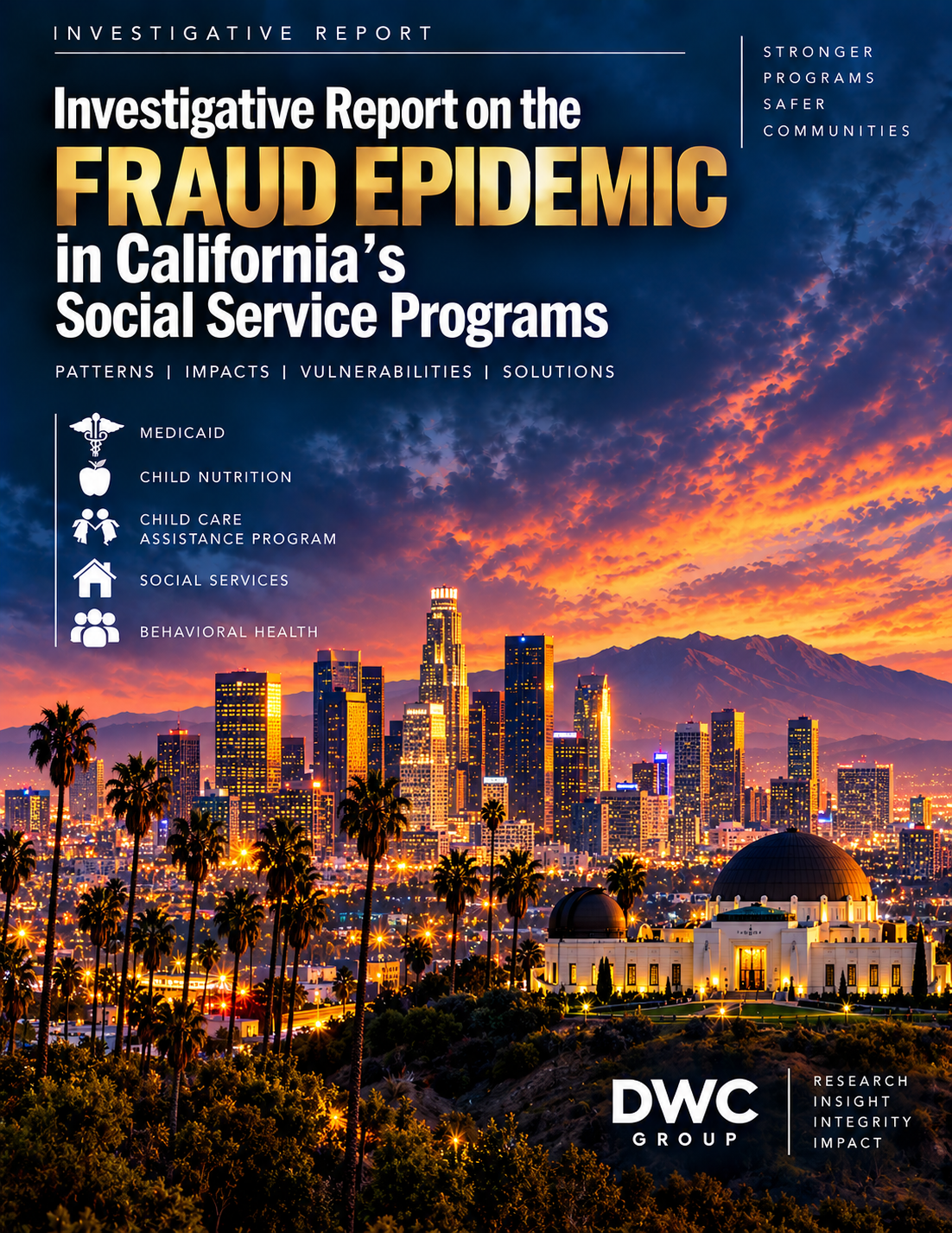
Investigative Report on the Fraud Epidemic in California’s Social Service Programs
A comprehensive examination of fraud risk, systemic vulnerabilities, oversight failures, and program-integrity solutions across California’s social-service system.
Prepared by DWC Group, this investigative report examines fraud and misuse risks affecting California’s massive network of publicly funded social-service programs, with particular attention to Medi-Cal, in-home and community-based services, behavioral health, childcare subsidies, and other high-risk assistance programs.
California administers one of the nation’s largest Medicaid and social-service systems, serving millions of residents through a complex network of state agencies, counties, managed-care organizations, contractors, and private providers. This report examines how that scale and fragmentation can create vulnerabilities involving improper claims, phantom services, inflated billing, weak documentation, provider-verification gaps, fragmented data systems, and inadequate real-time oversight.
Inside the Report
Readers will explore:
- Patterns of Fraud & Misuse — Including rapid provider billing growth, phantom or “billed-but-not-provided” services, inflated attendance, documentation deficiencies, ownership and geographic mismatches, and other recurring fraud-risk indicators.
- Medi-Cal & Social-Service Vulnerabilities — An examination of risks involving in-home supportive services, home- and community-based services, behavioral health, substance-use treatment, childcare subsidies, and related programs.
- Data Analytics & Fraud Detection — A framework for identifying suspicious providers through growth ratios, billing patterns, attendance-to-billing comparisons, documentation completeness, geographic anomalies, prior compliance history, and other indicators.
- Fraud-Risk Scorecards & Dashboards — Practical concepts for transforming fragmented program data into centralized tools capable of identifying higher-risk providers earlier.
- Pre-Payment Controls — Strategies for moving beyond traditional post-payment audits through documentation gates, targeted reviews, provider screening, site verification, and risk-based payment controls.
- Real-Time Verification — Approaches for strengthening evidence that publicly funded services were actually delivered.
- Whistleblower Protection & Accountability — An examination of reporting channels, anti-retaliation protections, transparency, and institutional accountability.
- Governance & Internal Controls — Analysis of how fragmented oversight, data silos, weak monitoring, and leadership decisions can affect program integrity.
- Investigations & Enforcement — Examination of the roles of state and federal oversight, fraud-control units, auditors, investigators, and enforcement authorities.
- Recommendations & Next Steps — A proposed framework for stronger prevention, early detection, oversight, transparency, and protection of public funds.
From Reactive Enforcement to Proactive Fraud Prevention
Rather than treating fraud solely as an enforcement problem discovered after public money has already been spent, the report presents a proactive program-integrity framework centered on fraud-risk scorecards, pre-payment controls, real-time verification, stronger data integration, whistleblower protections, and governance reforms.
California is also examined as a case study for other jurisdictions managing large Medicaid and social-service portfolios. The report identifies lessons that oversight agencies can use to strengthen vulnerable programs before suspicious billing and control failures develop into substantially larger losses.
Who This Report Is For
Government agencies, legislators, policymakers, Medicaid Fraud Control Units, auditors, investigators, compliance and program-integrity professionals, public administrators, researchers, consultants, journalists, social-service executives, and organizations studying government fraud and public-sector accountability.
Prepared by DWC Group
For investigative, educational, research, policy-analysis, and professional reference purposes.
Reviews
There are no reviews yet.